

Recently, 45 businesses in Singapore found themselves having to do something rather embarrassing: publicly apologise for buying fake reviews.
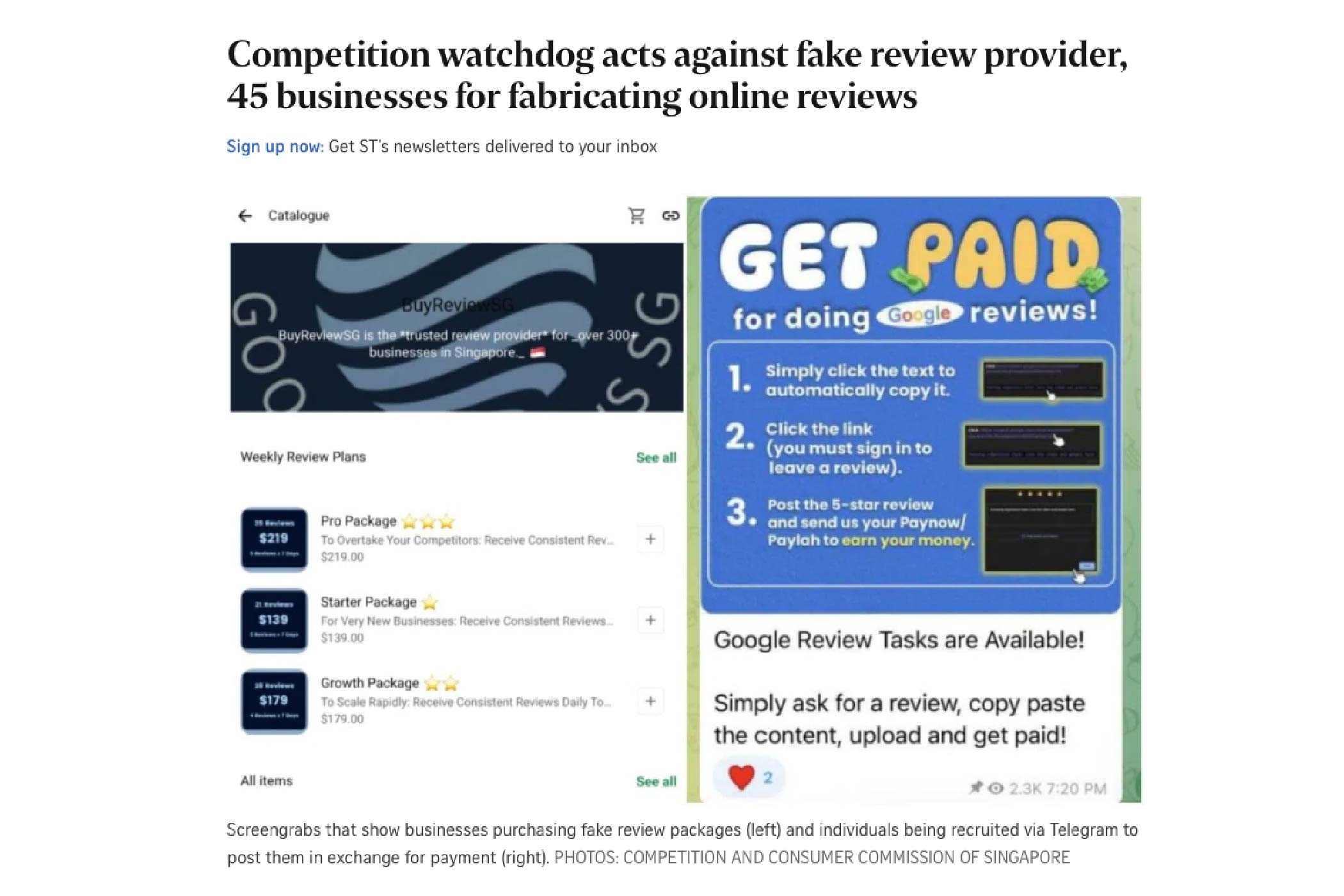
Image Credits: The Straits Times
The Competition and Consumer Commission of Singapore (CCCS) took action against the businesses after investigating a provider selling fabricated online reviews.
What fascinated me was how sophisticated the whole thing had become. This wasn't simply somebody creating 50 Gmail accounts and typing:
“Very good service. Highly recommended.”
AI could generate different writing styles and believable customer experiences. People could be paid to post the reviews. There was apparently even a system that helped businesses work out how many five-star reviews they needed to reach their desired rating.
Think about that for a moment.
We have reached the point where businesses can essentially calculate how much artificial happiness they need to purchase.

Buying Fake Reviews is Wrong
Let's get the obvious part out of the way first. Buying fake reviews is wrong. If you've never eaten at the restaurant, bought the product or renovated your home with a company, you shouldn't pretend you have. A fabricated customer experience presented as genuine is misleading.
However, after reading about the case, I found myself less interested in the businesses that bought the reviews and more interested in why reviews have become valuable enough for an entire fake-review industry to exist.
Perhaps there is something fundamentally strange about the way we've built the review economy.
Imagine a company serves 100 customers. Most of them have a perfectly decent experience. They receive what they paid for, everything goes reasonably well, they say “Thanks ah” and continue with their lives.
How many of them voluntarily go home, open Google and spend ten minutes writing about it?
Probably not many.
Now imagine three customers have a terrible experience. Suddenly, people become very motivated writers. There will be photographs. Screenshots. Dates. Names. Maybe even a 1,200-word chronology with supporting evidence.
The happy customer says, “Thanks.”
The angry customer asks: “Where is your Google review page?”
That's one of the peculiarities of online reviews. They aren't necessarily a representative survey of everyone who has dealt with a company. They're a collection of experiences from people who were sufficiently motivated to write about them.
Sometimes they're motivated because they're delighted. Sometimes because they're furious. Sometimes because the salesperson WhatsApped them three times asking:
“Boss, can help me give five stars?”
Which explains another strange modern phenomenon.
Businesses have started begging for reviews.
Businesses are “Begging” for Positive Reviews
You finish dinner and there's a QR code on the table. You buy something and there's a card offering a voucher for leaving feedback. Your salesperson messages you afterwards asking you to mention his name.
Sometimes I feel businesses put QR codes everywhere except inside the toilet bowl... Of course, I understand why.
We've created an environment where those little yellow stars have enormous commercial value. They influence whether people click, whether people enquire and whether people trust a business they've never encountered before.
So naturally, businesses want more of them.
The problem is that somewhere between “Please share your honest experience” and “Please give us five stars”, the purpose of the review starts changing.
Somewhere between that and “Why don't we just buy another 50?”, the whole thing completely loses its meaning.
There's another side to this conversation that I don't think gets discussed enough.
Businesses can also be victims of the review economy. In truth, not every negative review is necessarily an objective account of what happened.
Businesses sometimes receive reviews from people they cannot identify as customers. Disputes can be exaggerated. Competitors can potentially behave maliciously. Former employees can be disgruntled.
Sometimes a perfectly legitimate disagreement between two parties becomes a one-star declaration that the company is the worst organisation to have existed since the East India Company.
That doesn't mean businesses should dismiss negative reviews as fake.
Quite the opposite. Bad reviews can reveal very real problems, but perhaps consumers shouldn't automatically think that five stars mean propaganda while one star means truth either.

Reviewing Renovation is Complex
Nowhere is this complexity more obvious to me than in renovation.
Imagine two homeowners engage the same interior design company.
The first homeowner writes:
“Amazing designer. Very patient. Five stars.”
The second writes:
“Worst renovation company ever. Avoid at all costs.”
So who's lying?
Maybe neither.
One homeowner may have worked with a senior designer while the other had somebody inexperienced. Different project managers may have handled the jobs. Different subcontractors may have been involved. One renovation could have been a straightforward four-room flat while another involved complicated structural, carpentry and coordination work.
Even expectations can be completely different. One homeowner sees a small laminate joint and thinks, “Okay lah.” Another sees the same joint and starts preparing evidence for our Sub Courts.
Yet somehow all of this complexity gets compressed into one number:
4.3 stars.
We treat that number as though it were a scientific measurement of the company, and the more I think about it, the stranger that becomes.
Nobody is Perfect
If an interior design company has completed hundreds or thousands of projects, I actually expect some unhappy customers.
As my friend Jason from Plunt.co said before:
“The best gardeners probably killed the most plants…”
That's simply reality.
Renovation involves money, expectations, construction, human beings and months of interaction. Things will occasionally go wrong.
So when I see a company with an enormous number of reviews and practically everybody apparently had the most wonderful experience of their lives, I don't necessarily become more confident. I become more suspicious.
This is because real businesses are messy and real customers with real situations will often disagree.
Not every project will go perfectly.
In my opinion, perhaps ironically, a few credible negative reviews can make the positive ones more believable.
In fact, I've increasingly found that the most useful review may not even be a five-star review.
If you end up reading this:
“Three stars. Design was good and we liked our designer. There were workmanship issues with the carpentry and tiling, but the company came back several times and eventually rectified everything.”
Now that's useful.
I know what went wrong. I know what went right. More importantly, I know what the company did when something went wrong, and personally, that tells me far more about a renovation company than another:
“Amazing service!!! Highly recommended!!! ⭐⭐⭐⭐⭐”
Perhaps reputation isn't really about never having problems. It's about what you do when problems happen.
Which is why I think we need to change the way we use reviews.

A Review Shouldn't Be a Verdict
A review shouldn't be a verdict. It should be evidence.
If I'm considering giving an interior design company $80,000 to renovate my home, surely I should investigate more than whether it has 4.8 stars instead of 4.6.
I want to understand what people are actually saying.
Are complaints recurring? Are they about workmanship, communication, pricing or delays? When somebody complains publicly, does the company respond constructively or start fighting with the customer in the comments section?
I'd also want to see actual completed projects, understand who owns the company, know how long it has operated and find out whether the person presenting himself as my interior designer actually has the experience to design my home.
Suddenly the star rating becomes what it probably should have been all along:
Just one piece of information among many that helps to form a full impression of the business.
This is probably the bigger lesson we can learn from Singapore's fake-review episode.
Yes, businesses shouldn't buy reviews.
But fake reviews exist because we've made reviews extraordinarily powerful. Consumers look at them, so businesses chase them. Businesses chase them, so marketing agencies sell services around them.
Once those stars become commercially valuable enough, somebody inevitably discovers that there's money to be made manufacturing them. And it doesn’t help that AI is making the whole thing even easier.
Which creates a rather absurd situation.

Manufacturing trust
We're using increasingly sophisticated technology to manufacture something that was originally supposed to represent one of the most human things imaginable:
Trust.
Maybe consumers need to become more sophisticated too. I am not saying we should abandon reviews, but perhaps we need to learn to read them differently.
A 4.9 isn't automatically better than a 4.5. A one-star review isn't automatically more truthful than a five-star review. A business with some unhappy customers isn't automatically a bad business.
Look for patterns. Read the stories. Understand the context. Pay attention to how businesses behave when they're criticised. Then compare those reviews with evidence outside the review platform.
Choosing somebody to renovate your $80,000 home simply because strangers on the internet collectively gave them 4.8 yellow stars is actually quite strange when you stop and think about it.
Perhaps the question shouldn't be:
“Do the reviews tell me I can trust this company?”
It should be:
“Do the reviews give me enough information to decide whether I trust this company?”
Those two questions sound similar, but really they're not. One outsources your judgement and the other informs it. Perhaps that's what reviews were supposed to do in the first place.
Frequently Asked Questions About Online Reviews in Singapore
Are online reviews reliable when choosing an interior designer in Singapore?
Online reviews can be useful, but they should be treated as one source of information rather than a final verdict. Look beyond the overall star rating and read what homeowners actually say about workmanship, communication, pricing, delays and how the company responded when problems occurred.
Should I avoid an interior design company with negative reviews?
Not necessarily. A negative review can provide useful context, particularly when it explains what went wrong and how the company responded. Look for recurring patterns across multiple reviews rather than judging a company based on one unhappy customer's experience.
Why can reviews of the same interior design company be so different?
Renovation experiences can vary depending on the designer, project manager, subcontractors, complexity of the renovation and the homeowner's expectations. Two homeowners can therefore have genuinely different experiences with the same company. This is one reason a single overall star rating cannot tell the whole story.
What should I look for when reading renovation reviews?
Look for specific details rather than simply counting five-star and one-star ratings. Pay attention to recurring comments about workmanship, communication, project management, pricing and delays. It is also useful to see how the company responds publicly when a homeowner raises a problem.
How should I check an interior design company beyond online reviews?
Reviews should be compared with other evidence. Look at the company's completed projects, how long it has operated, who runs the business and the experience of the interior designer handling your project. For a major renovation investment, a star rating should be only one part of your decision.


